Sources:
- http://entrancechemistry.blogspot.sg/2011/05/extraction-of-aluminium-from-bauxite.html
- http://www.chemguide.co.uk/inorganic/extraction/aluminium.html
- http://sam.davyson.com/as/physics/aluminium/siteus/extraction.html
- http://en.wikipedia.org/wiki/Bauxite
- http://en.wikipedia.org/wiki/Bayer_process
- http://en.wikipedia.org/wiki/Hall%E2%80%93H%C3%A9roult_process
- http://en.wikipedia.org/wiki/Red_mud
About Bauxite:
Bauxite
is an aluminium ore that contains a mixture of aluminium oxides( Al(OH)3, γ-AlO(OH),
and α-AlO(OH etc.) as well as iron oxides,silicon dioxide and
titanium oxide.
As aluminium is high up in the reactivity series, a pure sample of aluminium cannot be obtained by reduction with carbon. Furthermore, aluminium forms a stable compound with oxygen and cannot be displaced easily.
Therefore Aluminium has to be purified with two different methods, the Bayer Process or Electrolysis.
Bayer Process:

Industrial set-up for the Bayer Process.
During the Bayer Process, crushed bauxite is broken down or digested by a solution of hot concentrated NaOH solution, according to this reaction: Al2O3 + 2 NaOH + 3 H2O → 2 NaAl(OH)4
In the digester Sodium tetryhydroxoaluminate will be dissolved as solution while the other impurities in the ore will not react and remain insoluble.
Next All of these solids are filtered out. The residue is known as 'red mud'.
Then sodium tetryhydroxoaluminate is cooled in the precipitator. Crystallisation takes place, producing a precipitate of Aluminium hydroxide, Al(OH)3, or alumina and sodium hydroxide.
NaAl(OH)4 → Al(OH)3 + NaOH
Aluminium Hydroxide is then purified in the Rotary Kiln by heating to temperatures between 1000 to 1200 degrees celsius. Aluminium hydroxide is then decomposed into aluminium oxide and water.
2 Al(OH)3 → Al2O3 + 3 H2O and is collected for electrolysis.
Electrolysis or the Hall-Heroult process:
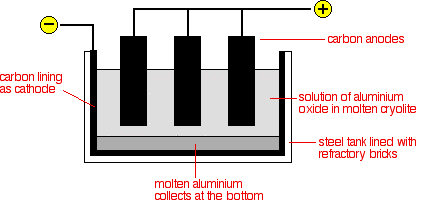
simplified Electrolysis cell.
Aluminium Oxide is
first dissolved in a mixture of molten cryolite, Na3AlF6, and Aluminium fluoride to
lower the melting point of aluminium
oxide in the set-up shown above. A negative current will be passed through the
carbon lining of the
set-up while a positive current will be passed
through the carbon anodes. This electrolyses the aluminium oxide,
cryolite
and the aluminium fluoride, causing liquid
aluminium to be formed in the cathode. Meanwhile oxygen gas reacts with
carbon from the anode to form carbon
dioxide.
Liquid Aluminium is taken out with a siphon and
is transported elsewhere to be cast into aluminium ingots.
Environmental impact:
Red Mud expelled in the early part of the experiment is accumulated in small containments or disposed of in the lakes and rivers. As the mixture is a strong alkali, it would adversely affect the pH of the soil, leading to complications in its disposal.
We believe that as red mud is a mixture of the waste products from bauxite, such as haematite and silicon dioxide, it can be taken away for iron to be produced instead of dumped.
Research by: Wei Liang and Radhika
Write up by: Elizabeth
